7 Signs You're Still Parenting From Your Childhood (Not Your Values)
Blog post description.
ROOTED IN HEALINGBREAK THE CYCLECONSCIOUS PARENTING
LRTK
3/18/20266 min read
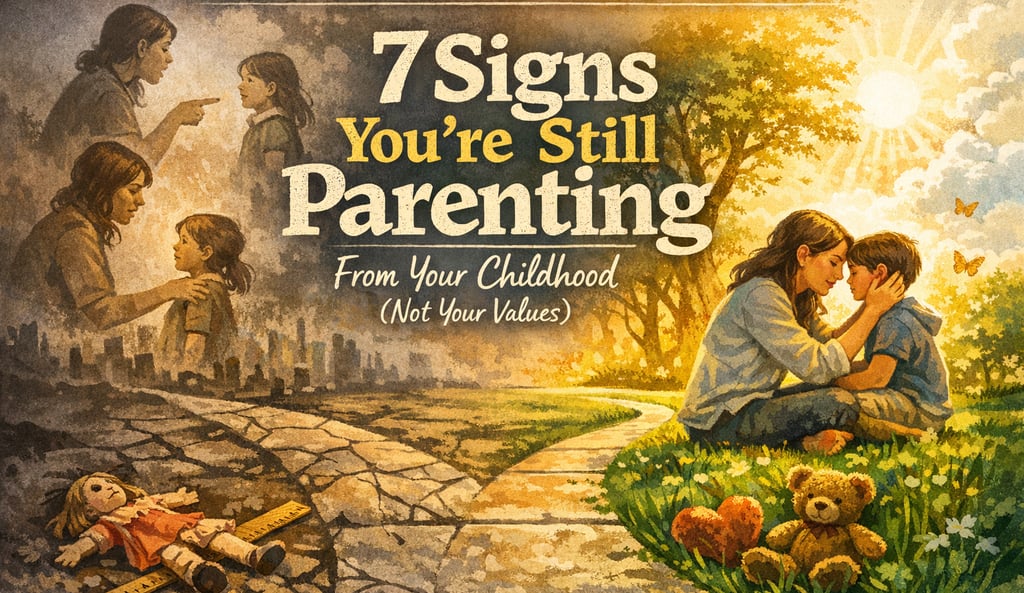
I didn't realize I was doing it until my son looked at me the way I used to and sometimes still look at my mother.
That look. The one that says: I don't know which version of you I'm going to get today.
I had promised myself I'd be different. And in so many ways, I was. But in that moment, I wasn't parenting from my values. I was parenting from my past — from a place in me that never quite finished healing.
The hard truth is that most of us are doing this more than we know. Not because we're bad parents. Because the patterns we inherited were installed early, quietly, and without our permission. They don't announce themselves. They just show up — in our reactions, our tone, our rules, our silences.
Here are 7 signs worth paying attention to. Not to shame yourself — but to finally see what's been running in the background.
Sign 01: You react before you can think
Your child does something — spills a drink, talks back, cries too loudly — and before you've consciously decided anything, you've already responded. The voice. The look. The sudden sharpness that surprises even you.
This is your nervous system, not your values, doing the parenting. And your nervous system learned how to respond in a home that may have had very different rules about emotions, noise, and mistakes than the home you're trying to build.
Reacting before you think isn't a character flaw. It's a stress response that was wired in long before you became a parent. The question isn't whether it happens — it's whether you know when it's happening.
NOTICE IF:
Your reactions feel automatic and familiar — like something clicks on before you choose it.
Sign 02: You hear your parent's words coming out of your mouth
"Because I said so."
"Stop crying or I'll give you something to cry about."
"You're too sensitive."
"I didn't have it this easy."
You swore you'd never say those things. And then one hard evening, you did. Maybe it shocked you. Maybe it didn't — maybe it slipped out so naturally that you barely noticed.
Words like these aren't just phrases. They're emotional blueprints. They tell children what their feelings are worth, whether their needs are too much, and what kind of love is conditional. When we repeat them, it's rarely because we believe them. It's because they were the language of our earliest home, and under stress, we revert to our first language.
NOTICE IF:
You've caught yourself using words or a tone that sounded exactly like someone from your childhood — and felt a quiet unsettledness afterward.
Sign 03: Certain emotions in your child make you deeply uncomfortable
Not all big feelings are equal in our nervous systems. For some parents, anger is unbearable to witness. For others, it's sadness — a child crying can feel almost threatening. For others it's neediness, or fear, or joy that's too loud and too free.
The emotions that make us most uncomfortable in our children are almost always the emotions that were most unwelcome in us growing up. We didn't learn how to hold those feelings because nobody held them for us. So now, when our child brings them, we don't know what to do — so we shut it down, dismiss it, or disappear from it.
The discomfort isn't about your child. It's about what their feelings are asking you to feel too.
NOTICE IF:
One specific emotion in your child consistently makes you want to fix it, stop it, leave the room, or get frustrated — faster than any other.
Sign 04: You confuse control with safety
For many of us, control was how love looked in our childhood home. Rules kept things predictable. Strict expectations meant someone cared. Obedience was rewarded. Chaos — even the normal chaos of childhood — was treated like a threat.
So now, when things feel out of control, the parenting instinct is to clamp down. More rules. Louder voice. Firmer consequences. Not because those things are necessarily wrong — but because the driving feeling underneath them isn't reason. It's fear. And fear doesn't make good parenting decisions.
Safety and control are not the same thing. Children need boundaries, yes. But they also need to know that the adult in the room can tolerate uncertainty without becoming a source of threat themselves.
NOTICE IF:
You feel a specific kind of anxiety when your child doesn't follow the rules — less like a parent setting limits and more like something urgent and old is being triggered.
Sign 05 You take your child's behavior personally
When your child is defiant, you feel disrespected. When they're struggling in school, you feel like you've failed. When they're having a hard time socially, it somehow reflects on you. When they're embarrassing in public, you feel a shame that goes deeper than the moment.
This is one of the quieter signs — and one of the hardest to admit — because it feels so much like just caring. But there's a difference between caring about your child and needing your child's behavior to manage your own emotional state.
When your child's choices become about your worth, your identity, or your past — you're no longer fully present with them. You're somewhere else. Somewhere older.
NOTICE IF:
Your child's mistakes or struggles feel like a verdict on you as a person, not just a moment that needs guidance.
Sign 06 Repair feels foreign or uncomfortable
In some homes, apologies didn't happen. Adults didn't come back after a hard moment and say "I shouldn't have handled it that way." The rupture just... sat there. Or everyone pretended it didn't happen. Or the child was expected to move on and be fine.
If that was your experience, repair may feel uncomfortable now — even when you know it's the right thing to do. Saying "I was wrong" to your child might feel like you're losing authority. Coming back to reconnect after an argument might feel unnecessary. The silence might just feel like how things go.
But repair is where the real parenting happens. It's what teaches your child that relationships can hold hard things — and that love doesn't disappear when things go wrong. If repair feels hard, it's worth asking where you learned that it wasn't necessary.
NOTICE IF:
After a hard moment with your child, you find it difficult to go back in, acknowledge what happened, and reconnect — even when you want to.
Sign 07 You parent from fear more than intention
Fear-based parenting doesn't always look like yelling or punishment. Sometimes it looks like overprotecting. Over-explaining. Saying yes when you mean no because conflict feels dangerous. Staying quiet about hard things because you're afraid of making it worse.
Fear of repeating the past. Fear of losing your child's love. Fear that if you're too soft, they won't be okay. Fear that if you're too firm, you're becoming someone you swore you'd never be.
When fear is driving, it's almost always because some part of you is still parenting the child you were — trying to give them what you didn't have, trying to protect them from what hurt you — instead of being fully present with the child in front of you.
NOTICE IF:
When you look at your parenting choices — the rules, the responses, the things you avoid — more of them are driven by fear of something than by a clear sense of who you want to be.
This Isn't About How You're Failing. It's About What You're Carrying.
If you saw yourself in more than one of these signs, that's not a reason to spiral. It's actually a reason to exhale.
Because awareness is the first move. Not fixing everything overnight. Not a complete overhaul of how you parent. Just the willingness to see the pattern — to name the thing that's been running quietly in the background — and to decide that you want to respond from somewhere different.
Every parent on this list is also a parent who cares. You don't go looking for patterns if you don't care about the home you're building. The fact that you're here, reading this, already means something is shifting.
You are not your patterns.
You are the parent who is willing to look at them.
Ready to Go Deeper?
If this resonated, the next step is understanding which pattern you're operating from — and what it's protecting you from.
Two places to go from here:
Take the Protective Parenting Pattern Quiz — a short quiz that helps you identify your pattern and what healing can look like. Find it here
Read the Pillar Post: What It Really Means to Heal the Parent First — a deeper look at why healing yourself is the most child-centered work you can do.
You don't have to parent from the past. But first you have to be able to see it.
Parent Pause
Pick the one sign that felt most familiar. Don't overthink it — go with the one that landed first.
Sit with this question: Where did I first learn this pattern? When was the earliest time I remember this feeling?
You don't need to answer it today. Just let the question be there.
Contact Us:
heydannie@letsraisethesekids.com
© 2023 Let’s Raise These Kids. All Rights Reserved.
Let’s Raise These Kids
Heal the Parent. Raise the Child. Shift the Legacy.
Home | Blog | Resources